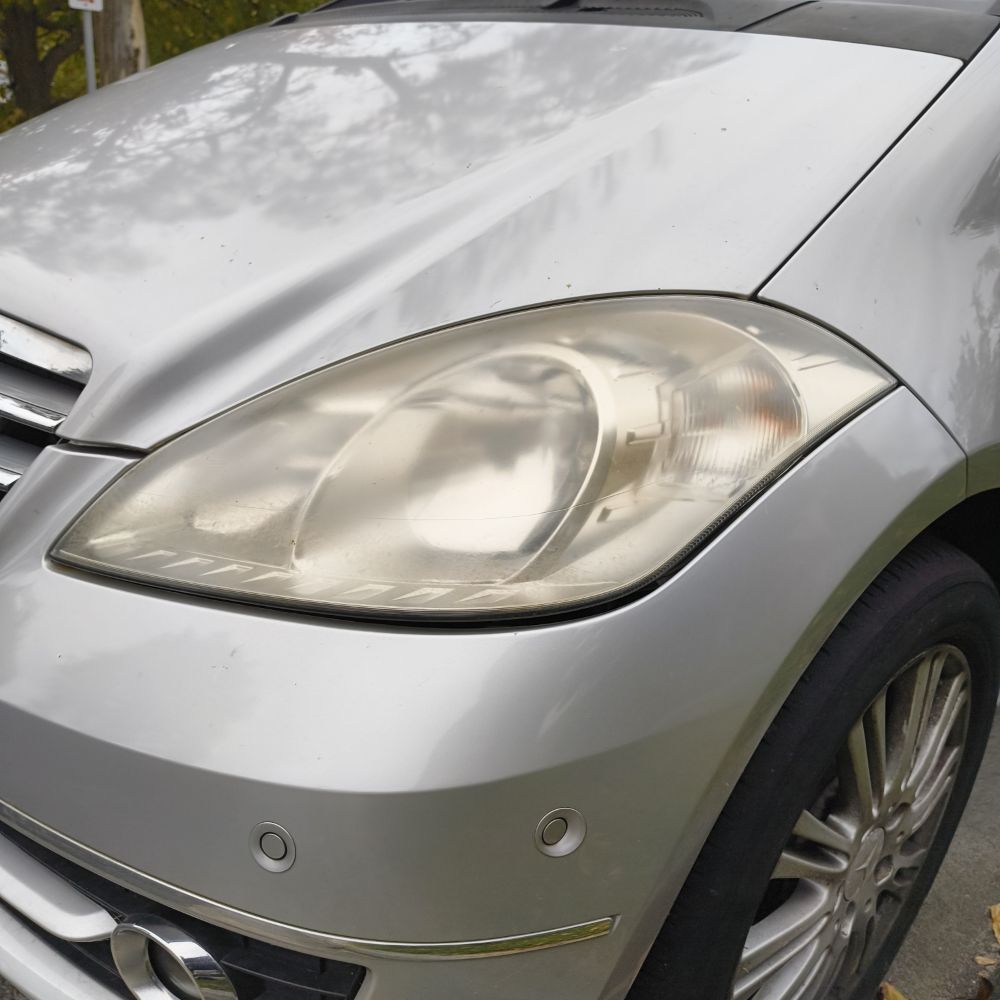
A guide on what causes headlights to become foggy and yellow.
Table of Contents
What Causes Headlights to Become Yellow and Foggy?
If your headlights have gone cloudy or yellow, you’re not alone. It’s one of the most common issues on Australian cars, and it’s not just cosmetic. Degraded headlights reduce your visibility at night and can make your car legally unroadworthy.
Most people assume the fog is just dirt or grime that needs a wash. The real problem runs deeper.
What headlights are made of
Modern headlight lenses are made from polycarbonate plastic, not glass. The industry switched away from glass decades ago because polycarbonate is about 250 times more impact-resistant and weighs significantly less, which helps with fuel efficiency.
The inside of the headlight housing is typically polypropylene or Bulk Molding Compound (BMC), a heat-resistant thermoset plastic. The reflector is coated with a thin layer of aluminium applied through vacuum metallisation, which bounces up to 90% of the bulb’s light onto the road.
Why do they yellow and fog up?
Every factory headlight lens leaves the production line with a UV-resistant protective hard coat bonded to the polycarbonate. That coating is the difference between a headlight that stays clear for years and one that fails.
Sunlight, especially Australia’s UV levels, gradually breaks down this protective layer. Once the coating degrades, the bare polycarbonate underneath is exposed directly to UV radiation. The plastic oxidises. It turns yellow, then chalky, then opaque.
Road debris accelerates the damage. Sand, gravel, and tiny particles kicked up at highway speeds create micro-scratches in the already-weakened surface. These scratches scatter the beam instead of projecting it forward. Environmental contaminants – road salt, chemical residue, acid rain — settle into the now-porous plastic and speed up the breakdown.
A 2018 study by AAA found that deteriorated headlights can produce as little as 22% of their original light output1 . That means on an unlit road, a car with clouded headlights might give you enough visibility for roughly 60 km/h in new condition. Cut that by nearly 80%, and you’re driving with less light than you need to see and react to hazards.
Most headlights start showing visible degradation around the three-to-five-year mark, depending on how much direct sun the car gets and where it’s parked.
Does washing help?
Yes, but it’s not enough on its own.
Regular washing removes road grime, salt, and chemical contaminants before they can bond to the lens surface and eat into the remaining UV coating. A clean lens degrades more slowly than a dirty one.
What washing won’t do is restore a coating that’s already gone. Once the factory UV hard coat has failed, no amount of soap and water brings it back.
Can foggy headlights be fixed?
Yes. The process is called headlight restoration.
A proper restoration removes the oxidised outer layer of the polycarbonate lens through wet sanding with progressively finer grits, typically starting coarse to strip the damaged material, then refining to a smooth, optically clear surface.
The step that matters most is what happens after sanding. Without a new protective layer, bare polycarbonate re-oxidises faster than the original factory coating did. A quality restoration applies a UV-cured hard coat, not a wipe-on sealant or ceramic spray, that bonds to the plastic and blocks UV the way the factory coating did. Industry research published in UV+EB Technology confirms that UV-cured hard coats chemically bond to polycarbonate in a way that aftermarket wipe-on products cannot replicate2. Done right, a restored headlight stays clear for two to three years before needing attention again.
Consumer Reports tested multiple restoration products and found they all improved light output. Their top-rated kit restored clarity to near-new levels. The catch: the hazing returned within about a year on untreated lenses. The protective coat is what separates a maintenance job from a repair.
Headlight fogging in Australia
Australia’s UV index regularly hits extreme levels through summer, which means factory headlight coatings degrade faster here than in most other markets. In Victoria, a degraded headlight lens is technically unroadworthy and can attract a fine and demerit points.
If your headlights have started yellowing, a professional restoration restores both appearance and nighttime safety without the cost of replacing the entire headlight assembly.
Ready to get yours looking clear again? See our headlight restoration service
Here’s a recent Mazda 3 Foggy Headlight Restoration


Our Guarantee
12-Month UV Protection
We don’t just polish the plastic; we apply a premium UV ceramic coating. Melbourne’s harsh sun destroys unprotected lenses quickly, so we seal them properly. That is why every local headlight restoration is backed by our comprehensive 12-month warranty against future fading and yellowing. View Beam Renew Process
YOUR SAFETY
Clear Vision For Safer Driving
Safety isn’t just about passing a roadworthy inspection when it’s time to sell. It’s about protecting you and your family every time you drive at night. According to Victoria’s official Vehicle Standards, headlight lenses must not be “substantially faded.” Restore your clarity and drive with confidence. View Transport Victoria Standards
- AAA, “Headlamp Lens Deterioration,” December 2018. Deteriorated headlights produced only 22% light output on low beam compared to new OEM assemblies. [newsroom.aaa.com] ↩︎
- UV+EB Technology, “UV-A Hard Coat for Polycarbonate Headlight Refinishing,” 2024. Technical review of UV-cured hard coat chemistry, OEM vs aftermarket coating performance, and polycarbonate headlight refinishing standards. [uvebtech.com] ↩︎